
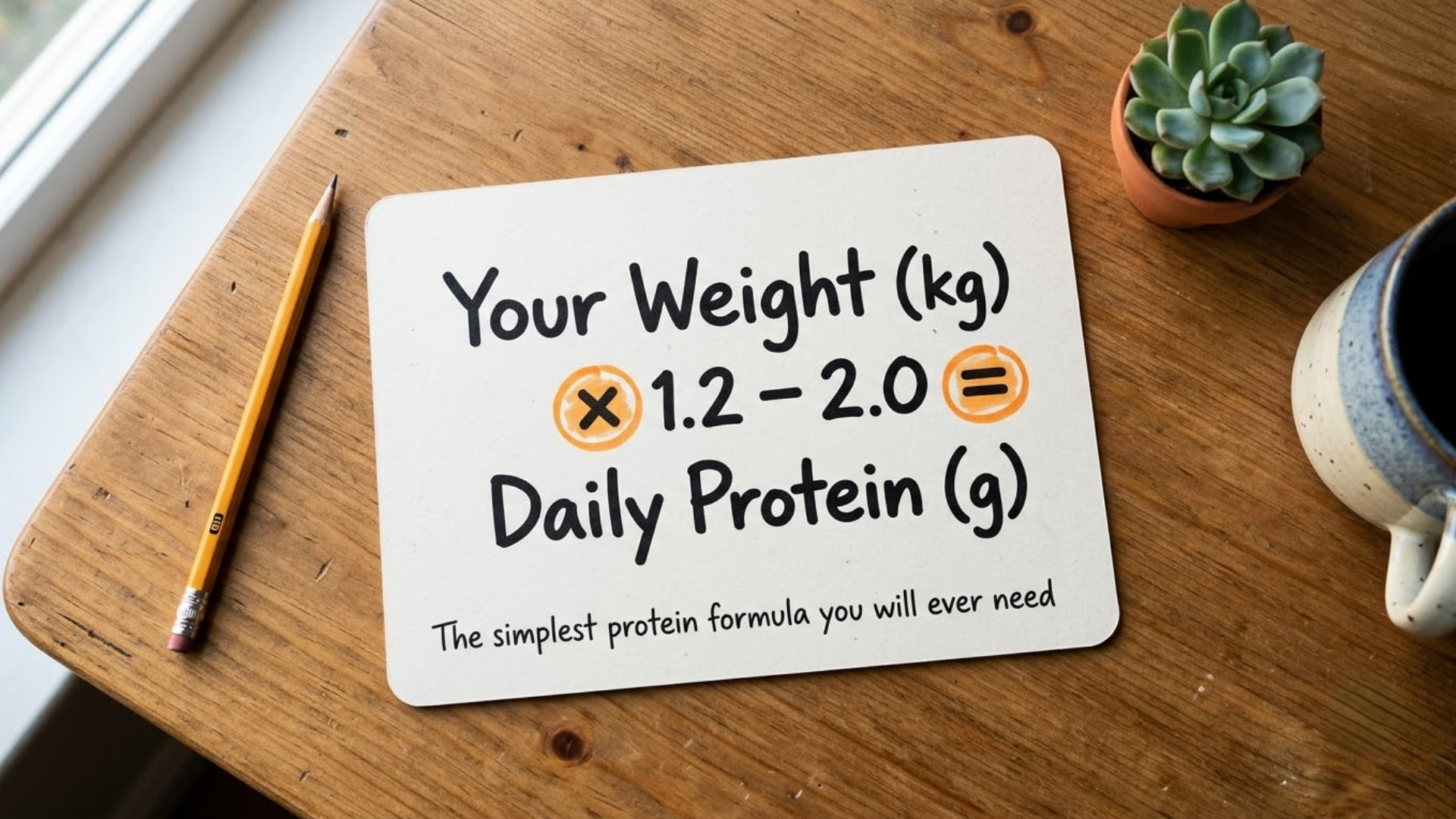
If you want the short answer to how much protein per day you need, here it is:
Your body weight in kilograms × 1.2 to 2.0 = grams of protein per day.
So if you weigh 70 kg, you need somewhere between 84 and 140 grams of protein a day.
That’s the whole formula. The rest of this article explains where that number comes from, how to pick your spot in that range, and what the number actually looks like on a plate.
Let’s keep it simple.
First, Why Does Protein Even Matter?
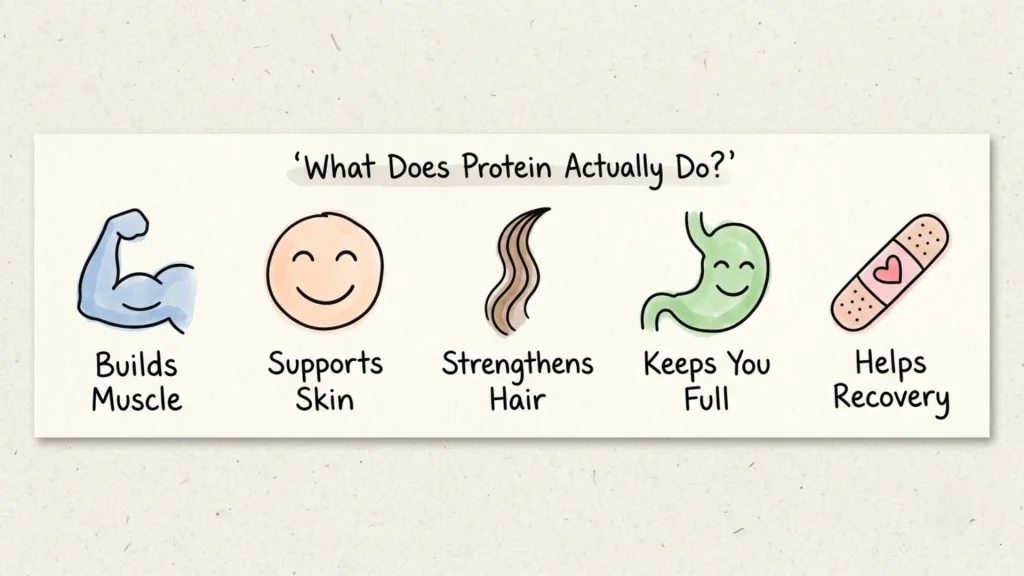
Think of protein as the building blocks of your body.
Your muscles, skin, hair, nails, and even parts of your blood are made from protein. Every day, your body breaks some of it down and needs new protein to rebuild. If you don’t eat enough, your body starts borrowing from your muscles.
Protein also:
- Keeps you full longer than bread or sugar
- Helps you keep muscle while losing fat
- Helps you recover after exercise
So this isn’t just a “gym people” thing. Everybody needs it.
The Official Minimum (And Why It’s Probably Too Low for You)
Health organizations like the World Health Organization set the minimum at about 0.8 grams per kilogram of body weight.
This is called the RDA. It is the amount that stops most people from being deficient. It is not the amount that helps you feel your best, build muscle, or lose fat easily.
Think of it like this: 0.8 g/kg is the minimum amount of water that keeps a plant alive. It doesn’t mean the plant is thriving.
Most research on active or weight-conscious adults points to a higher range, usually 1.2 to 2.2 g/kg. That’s the range we’ll use.
The Simple Math Formula (Step by Step)
Here’s the whole thing in three steps.
Step 1: Find your weight in kilograms.
If you know your weight in pounds, divide by 2.2.
- 154 lbs ÷ 2.2 = 70 kg
Step 2: Pick your goal.
| Your goal | Multiply by your kg |
|---|---|
| Just stay healthy, not very active | 1.0 – 1.2 |
| Active, exercise a few times a week | 1.4 – 1.6 |
| Want to lose fat and keep muscle | 1.6 – 2.0 |
| Want to build muscle | 1.6 – 2.2 |
| Over 60 years old | 1.2 – 1.5 |
Step 3: Multiply
Weight (kg) × your number = grams of protein per day.
A Worked Example
Let’s say Riya weighs 60 kg. She goes to the gym three times a week and wants to lose a bit of fat.
She picks 1.8 from the “lose fat” row.
60 × 1.8 = 108 grams of protein per day.
That’s her target. Done.
Try it yourself:
My weight: ______ kg
My goal number: ______
______ × ______ = ______ grams per day
Most people guess wrong here. Surveys of adults who track their food for the first time usually show the same thing: they think they eat plenty of protein, but when they actually add it up, they land well below their number. Do the math once. It takes 30 seconds, and the result might surprise you.
One Important Fix: If You Carry Extra Weight
If you are quite overweight, multiplying your current weight can give you a number that’s too high. Fat tissue doesn’t need much protein. Muscle does.
The easy fix: use your goal weight instead of your current weight.
So if someone weighs 110 kg but a healthy goal for them is around 80 kg, they’d do:
80 × 1.6 = 128 grams, not 110 × 1.6 = 176 grams.
This keeps the number realistic and much easier to eat.
How Protein Fits Into Your Total Calories
Protein is just one part of what you eat. Carbs and fats are the others.
Each gram of protein has about 4 calories. So if Riya’s target is 108 grams, that’s about 432 calories from protein.
To know how big of a slice that is, you need to know your total daily calories. That’s your TDEE (Total Daily Energy Expenditure). If you haven’t worked that out yet, read our TDEE guide first. It uses the same simple-math style as this article.
Once you know your TDEE, protein usually ends up being about 20 to 35% of your daily calories. The rest goes to carbs and fats.
What Does 100+ Grams of Protein Actually Look Like?
This is where most people get stuck. “108 grams” means nothing until you see it as food.
Here’s roughly what 30 grams of protein looks like:
| Food | Amount for ~30 g protein |
|---|---|
| Chicken breast (cooked) | About the size of your palm (120 g) |
| Eggs | 5 large eggs |
| Greek yogurt (plain) | About 1.5 cups |
| Lentils (cooked) | About 1.7 cups |
| Paneer / cottage cheese | About 150 g |
| Tofu (firm) | About 200 g |
| Whey protein powder | 1 scoop (usually 25–30 g) |
| Canned tuna | 1 can (about 140 g) |
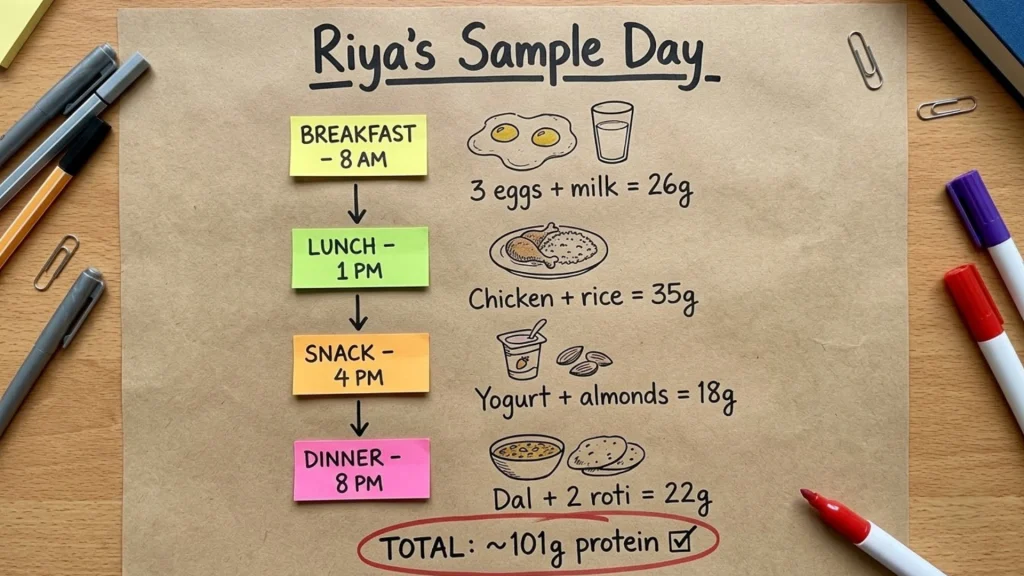
So Riya’s 108 grams could look like:
- Breakfast: 3 eggs + a cup of Greek yogurt (≈ 35 g)
- Lunch: palm-size chicken + rice (≈ 30 g)
- Snack: a handful of nuts + a glass of milk (≈ 15 g)
- Dinner: lentils with roti (≈ 25 g)
That’s about 105 grams. Close enough.
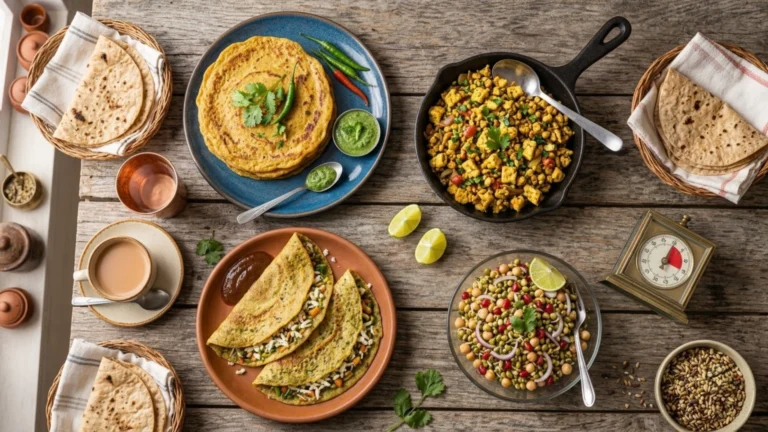
Want ready-made ideas? Check out our Recipes section. Each one lists the protein per serving so you don’t have to do math at the table.
Should You Spread It Out or Eat It All at Once?
Spread it out.
Your body uses protein best in chunks of about 25 to 40 grams per meal. Eating 100 grams at dinner and nothing else all day isn’t ideal.
An easy rule: aim for a palm-size portion of protein at every meal. If you eat three or four times a day, you’ll land close to your number without counting much.
Can You Eat Too Much Protein?
For most healthy people, going a bit over your number is not harmful. The body just uses the extra for energy.
Going way over (like 3 g/kg or more, every day) usually isn’t useful and makes your meals boring and expensive. It also pushes out carbs and fats you still need.
One real caution: people with existing kidney problems should talk to a doctor before raising their protein. This article is for general education, not medical advice.
Quick Recap
- Weight in kg × 1.2 to 2.0 = your daily protein in grams
- Pick a higher number if you exercise, want to lose fat, or build muscle
- If you’re overweight, use your goal weight
- Spread it across your meals, about a palm-size portion each time
- Protein is one slice of your calories—figure out the full pie with our TDEE guide
- Turn the grams into actual food with our recipes
Your turn: Did the formula give you a higher or lower number than you expected? Share it in the comments – it helps other readers see what’s normal.
Frequently Asked Questions ❓
How much protein per day to build muscle?
About 1.6 to 2.2 grams per kilogram of body weight. A 70 kg person would aim for roughly 112–154 grams.
How much protein per day to lose weight?
About 1.6 to 2.0 g/kg, using your goal weight. Higher protein helps you stay full and keeps your muscle while you lose fat.
Is 100 grams of protein a day enough?
For many people between 50 and 80 kg, yes. For bigger or very active people, it may be on the low side. Use the formula to check.
Do I need protein powder?
No. Powder is just a convenient food. If you can hit your number with regular meals, you don’t need it. If you’re struggling, one scoop can help.
How much protein can the body absorb in one meal?
Your body absorbs almost all of it, but it uses about 25–40 g at a time most effectively for muscle. That’s why spreading it out works better.
Does protein from plants count the same?
Yes, it counts. Plant proteins are slightly less complete, so people eating mostly plants can aim for the higher end of the range and mix sources (like rice + lentils).
This article is for educational purposes only and is not medical advice. If you have a health condition, especially kidney disease, please speak with a doctor or registered dietitian before changing your diet.
Sources:
- World Health Organization / FAO — Protein and amino acid requirements in human nutrition:: PDF (WHO IRIS repository): https://iris.who.int/handle/10665/43411
- International Society of Sports Nutrition – Position Stand: Protein and Exercise :: Journal page (open access): https://jissn.biomedcentral.com/articles/10.1186/s12970-017-0177-8 ; PubMed Central: https://pmc.ncbi.nlm.nih.gov/articles/PMC5477153/
- Morton et al., 2018 – Systematic review on protein and muscle gain, British Journal of Sports Medicine :: Journal page: https://bjsm.bmj.com/content/52/6/376 ; PubMed Central (free full text): https://pmc.ncbi.nlm.nih.gov/articles/PMC5867436/

💬 Join the Discussion